







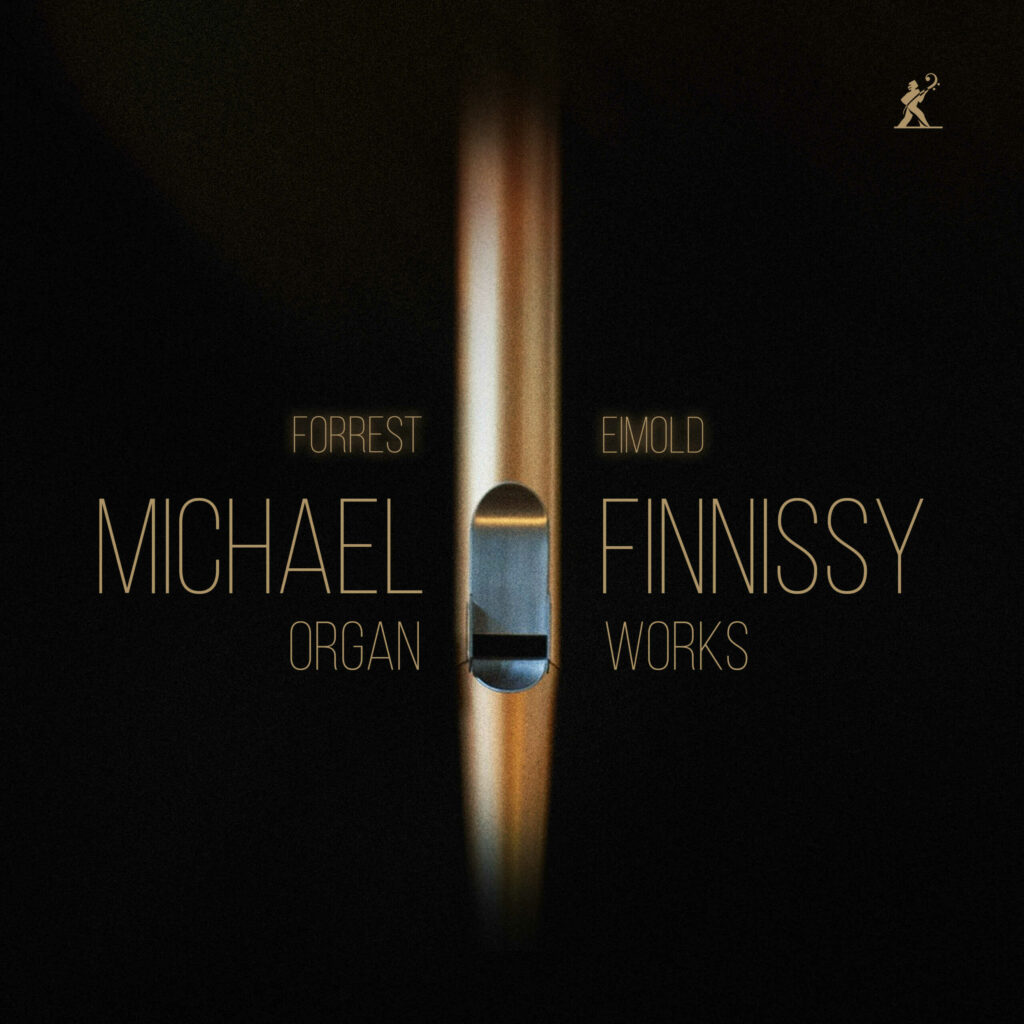
Prior to the publication of his four organ symphonies in 2009, Michael Finnissy’s organ compositions were little known beyond the small circle of organists to whom he dedicated his works (and who gave them their premieres). They have since been revered largely by wily contemporary-music organists enchanted by the frisson of their virtuosity and creative potential (including this reviewer, who devoted substantial time to the first two symphonies in his student days), yet they remain rarely performed.
The extraordinary challenges posed by Finnissy’s contributions to the organ repertoire were lying in wait for the prodigious technique and compelling musical mind of Forrest Eimold, the young organist who brings these works to life on this album. Having tackled much of the postwar “contemporary” organ repertoire in his teens, Eimold has since established himself as a singular interpreter of keyboard modernity, with a compositional mind to match (he is currently pursuing his doctorate in composition at the Yale School of Music). This album is a landmark achievement for organ music, due in equal parts to Eimold’s masterful and captivating realizations and the strength of the compositions by an artist of Finnissy’s stature.
One of the most esteemed and prolific English composers of the past 50 years, Michael Finnissy (b. 1946) has produced a body of work for nearly every classical instrumental and vocal combination. He is a pianist by training, and his piano compositions range from short vignettes to massive cycles, including the three-hour-long Verdi Transcriptions and the over five-hour-long The History of Photography in Sound. He is primarily known for his process of utilizing found objects (musical or otherwise) as an interface for musical thinking-through. For example, his “transcriptions” often reveal little surface similarity to the source material. Rather, Finnissy approaches transcription as a process of artistic transduction, an approach inspired by Busoni’s notions of transcription, but also by his affinity for the artistic practices of photography, cinematography, and painting, as well as the writings of Walter Benjamin and Susan Sontag. His process often results in compositions featuring extreme contrasts, juxtaposing plaintive solo or duo textures with canvases of multiply temporal planes of linear melodicism made up of inscrutably complex polyrhythms (his scores are meticulously hand-drawn). Consequently, many of his piano compositions are legendary for their stupefying technical difficulty, and his organ works are no different.
Mr. Finnissy’s organ compositions date from both his early student years in the 1960s and the height of his artistic maturity in the 21st century. Listeners new to his works may find two pieces at these extremes, . . . ere the setting sun . . .(1965) and Blackburn (2022, composed for this album), to be rewarding entry points into his organ oeuvre: the former a short evocation of a line from Shakespeare’s Macbeth, the latter a work of spare voicing and meditative austerity (including passages of functional harmony absent in the symphonies) belying an emotional power that threatens to erupt as much from its silences as from its sonic surface. The remainder of the two-disc album consists of the four symphonies, the student work Xunthaeresis, and a set of seven Hymn-Tune Preludes (the third, on the Norwegian sacred folk song “Bryd frem, mit hjertes trang,” is particularly inspired). The liner notes feature descriptive introductions to each piece by composer Christopher Fox.
Eimold is clearly undaunted by the works’ technical demands, particularly evident in his command over the more extreme passages of Xunthaeresis and the notorious first four pages of the Second Symphony. However, where this album transcends what could have simply been a recitation of technical bravado is through Eimold’s inspired orchestration and masterful evocation of large-scale temporal form. Finnissy provides few registration indications, apart from spare indications of pitch levels and general organ timbres. Against this dearth of specificity in the scores (or perhaps in consultation with the composer, who was present during the Blackburn recording sessions), Eimold brings clarity to the independent melodic layers in the scores through deft distinctions between the principal, flute, and reed families, constructing aggregations of surreal sonic beauty within each. For example, his use of high gap flute registrations in the second half of the First Symphony blends the bass and treble textures, evoking a gorgeously entangled web of polyphony not evident in the score. Unorthodox combinations across stop families in the Second Symphony affect a blurring and smearing of timbre that brings to mind broad brush strokes of thick oil paint, a richness of sound and texture commensurate with the Bruckner and Mahler works quoted within the piece.
Through Eimold’s extraordinarily imaginative registrations, one is struck by the sheer sonic beauty of Finnissy’s compositions, variously spare and austere or fiery and ardent, but never unapproachable. This perception is further amplified by Eimold’s masterful sense of timing and the responsive play of sound and silence within the room. The recording quality is outstanding, capturing a perfect balance of space and proximity to the pipework on each of the three organs. The close miking of the Harvard Fisk is particularly effective for the plaintive Hymn Tune Preludes, poignantly capturing the breath and vocality of the pipes in a manner befitting their source Norwegian folk and American shape-note hymns.
My only criticism is that we would have benefited from Eimold’s reflections in the liner notes. Finnissy’s works are processes of discovery by thinking-through, not only for the composer but for the interpreter. It would be wonderful to learn more about Eimold’s artistic process of encounter with these works and the composer. Of course, representational reification risks reducing artistic knowledge. However, I would encourage Eimold to consider further ways in which he might transpose, transduce, and expose his experiences of artistic entanglement within these magnificent works, making this album merely the starting point for our journey of productive encounter with Finnissy at the organ.