








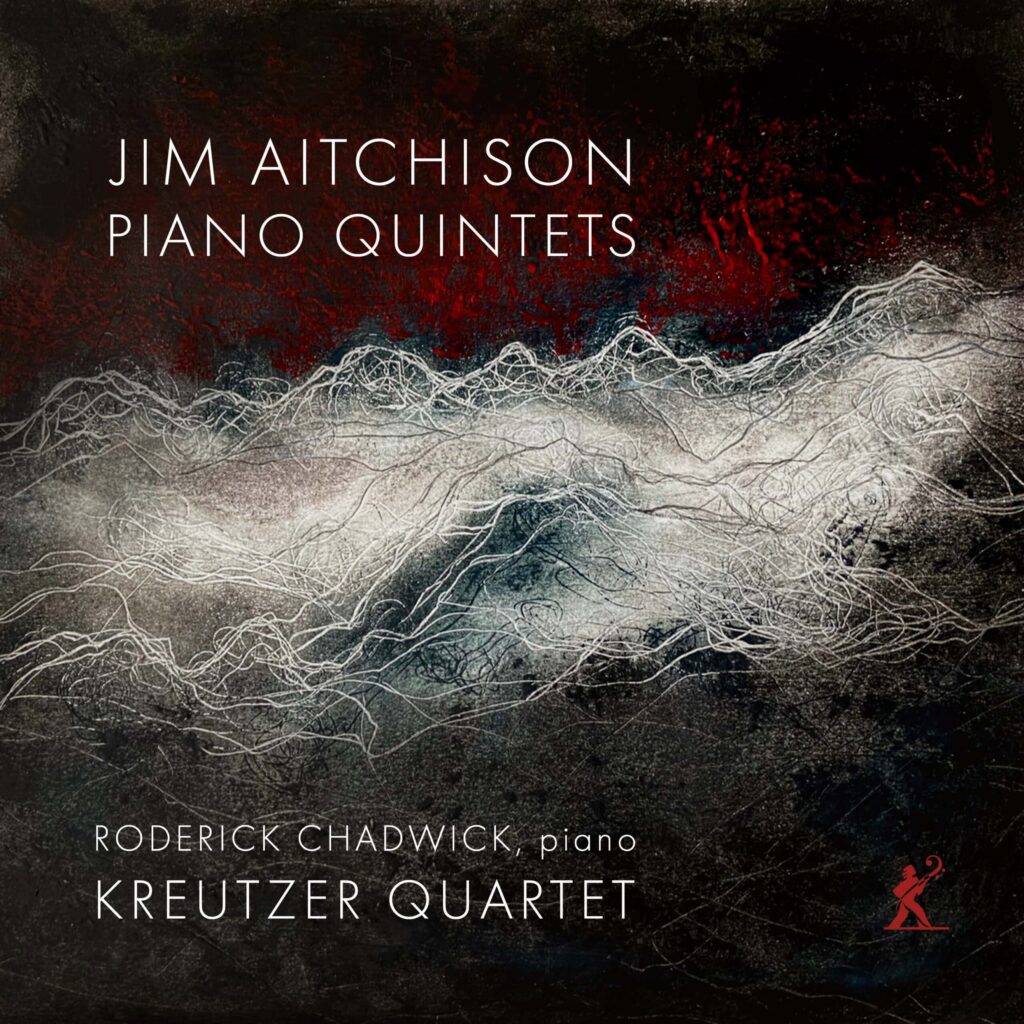
With this CD, the tens of thousands of composers whose music I’ve heard in my 75-plus years has been augmented by one—something that happens with every batch of CDs I receive from Fanfare Central. Indeed, in the batch of recordings assigned to me for the present issue, there were four discs devoted to composers new to me. As Samuel Clemens is alleged to have said, “The reports of my death are greatly exaggerated.”
In the booklet, Jim Aitchison is described as a composer “known for creating musical responses to the work of major visual artists,” as well as a visual artist himself. Perhaps Joel sent this disc to me because of my own interest in music inspired by visual art, especially in the case of Mussorgsky’s depictions of Viktor Hartmann’s paintings. Aitchison has written works inspired by artists and sculptors including Mark Rothko, Richard Deacon, John Hoyland, and Antony Gormley, all but the first of whom were previously unknown to me.
The composer describes his Piano Quintet No. 1, Margarete (completed in 2023), as “placing musical polarities in proximity as its basis, in both lesser and greater degrees of conflict,” while his Piano Quintet No. 2, completed the following year, “focuses upon the idea of emergence and change.” These descriptions offer insight into Aitchison’s compositional thinking but can only hint at what the music actually sounds like—that, after all, is the reviewer’s task. Both works, consistent with the composer’s artistic focus, draw their inspiration from the visual arts.
The First Quintet takes both its title and inspiration from Anselm Kiefer’s 1981 painting Margarete. The painting depicts towering frond-like structures formed from straw mixed into oil paint. For Kiefer, straw symbolizes energy, and the work belongs to a series confronting the legacy of Nazi rule. It was also conceived in response to Paul Celan’s poem Todesfuge(Death Fugue), itself a meditation on the Holocaust. The quintet’s opening movement, “Prelude and Chorale,” combines figures from Wagner’s Tristan und Isolde with Bach’s chorale O Haupt voll Blut und Wunden (“O Sacred Head, Now Wounded”). Aitchison conceals these references within a dissonant pianissimo string texture over which the piano traces almost atonal ascending figures. The resulting sound world suggests mystery and polarization, with steadily increasing intensity and dissonance.
The second movement, “Magic Square,” is considerably more fragmented, featuring seemingly random interjections from the various instruments. Here Aitchison draws not only on Margarete but also on his response to Albrecht Dürer’s enigmatic engraving Melencolia I. The movement’s title refers to the famous magic square embedded within the engraving, in which every row, column, and diagonal totals 34. Aitchison responds by creating a 34-note sequence, assigning a distinct duration, dynamic level, and timbre to each pitch. Aleatoric elements further enhance the movement’s disjointed, ametric character.
The third movement, “Dance Fugue,” combines the two ideas of its title through a partial double fugue intertwined with a barely recognizable reimagining of Brahms’s Hungarian Dance No. 5. Here Aitchison forces Brahms’s duple-meter csárdás into the Procrustean bed of a frenzied waltz. Nearly as long as the first two movements combined, this finale takes the listener on a wild sonic ride, hurling fragments of deconstructed Brahms in every direction amid an explosive succession of colors and gestures. Brahms with bombs!
Piano Quintet No. 2, Transience Patterns, inhabits a very different expressive world. Where the First Quintet explores conflict, the Second concerns itself with emergence and transformation. The two works remain connected, however, through their shared incorporation of Brahms, whose presence becomes even more pervasive here. This time Aitchison draws upon Brahms’s vocal canon Mir lächelt kein Frühling (“For Me No Springtime Smiles”). It is not a work I know well enough to recognize readily, but even if I did, Aitchison presents it only “through a glass, darkly.”
The opening “Prelude” introduces the canon in a gentle, exquisitely understated manner over occasional string pedal points. “Blind Tide” functions as an extended palate cleanser, becoming the only movement that dispenses entirely with Brahmsian material. Instead, it unfolds through a series of softly dissonant bass-register chords separated by stretches of silence. Aitchison likens its atmosphere to “dark marine undulations,” and indeed it is difficult to imagine music much darker than this.
All three remaining movements return, in one form or another, to Brahms’s canon. The third movement, “Autumn,” recalls much of the atmosphere established in the opening Prelude. “Winter (Fugue)” employs a fugue-like texture derived from the canon’s harmonies, repeating them while descending by semitone with each iteration. This is by far the busiest and most energetic movement of the quintet, placing formidable technical demands upon the performers, who meet them splendidly.
The work concludes with another gentle, spacious movement consisting of a series of chaconne variations. Here Aitchison presents a new harmonization of a six-note figure distilled from Brahms’s canon while pairing it with his own complementary six-note response. I found this closing movement to be the most exquisitely beautiful music on the entire disc. Listeners whose ears are attuned to contemporary musical aesthetics will discover much to admire throughout both quintets. The performers deliver compelling, committed interpretations of these innovative works, making it easy for me to offer this disc a strong recommendation.