








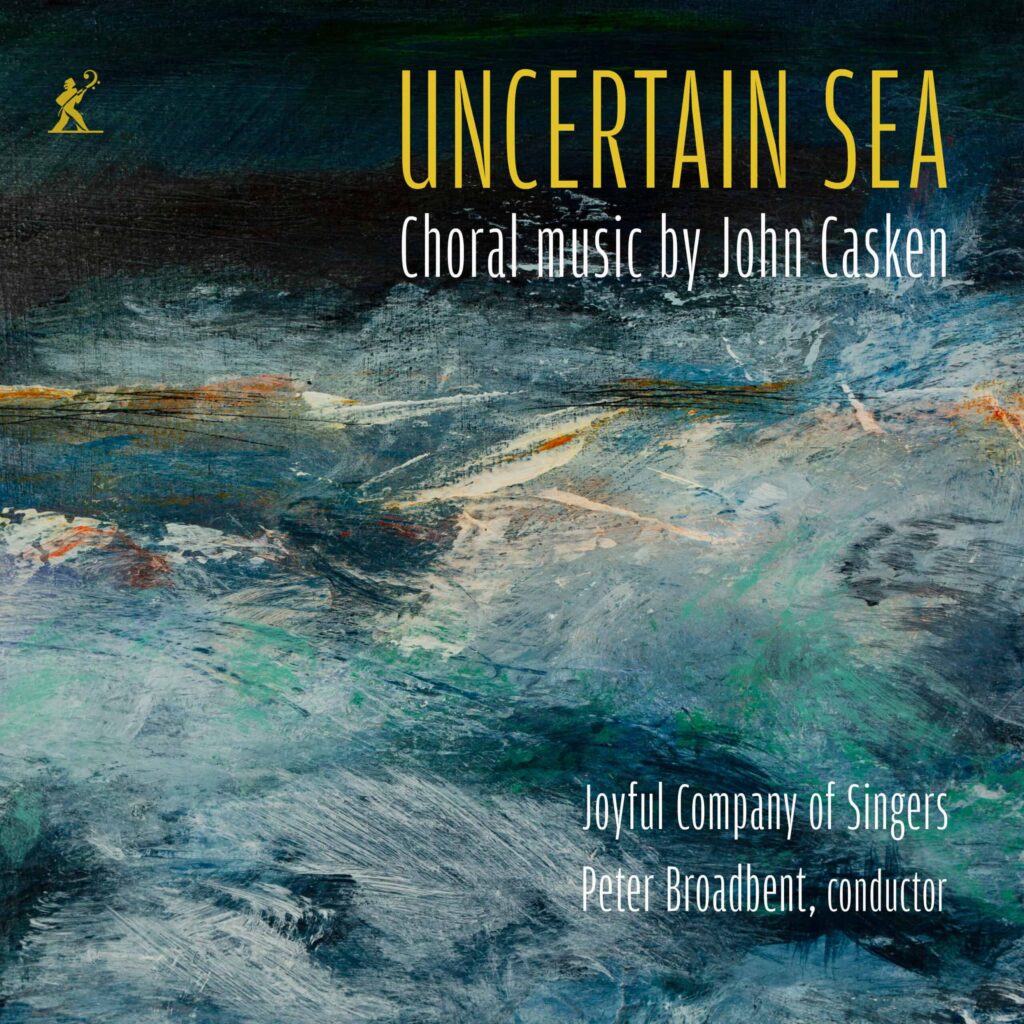
With a dozen listings in the Fanfare Archive, English composer John Casken is a known quantity to the readers of this journal. I myself have known and enjoyed his music for a good number of years, having heard a range of his works including a String Quartet and his opera Golem. The present discs introduce me (and perhaps the reader) to a generous sampling of his (mostly) unaccompanied choral music, including one stand-alone work and three choral cycles ranging from two to six movements. The composer lives in the coastal area of Northumberland, and three of the works heard here relate to the place of his habitation.
That is certainly true of the opening eight-minute Uncertain Sea, a setting of two interwoven poems by Katrina Porteous, herself from the Northumbrian region. Herein, she addresses the inherent challenges in her area, including the difficulties of the life of a fisherman and the decline of fishing communities there. Her poetry, often written in the local dialect (different enough from standard English that several of the words require definitions in footnotes), provides ample opportunities for Casken to set it effectively. Indeed, in the interest of complementing and illuminating the text, his setting draws upon various styles of choral singing, ranging from languid overlapping lines to strictly homophonic and rhythmically agitated gestures. The technical demands of this work are substantial, but director Peter Broadbent and his Joyful Company of Singers handle them with seeming ease.
Following is the longest (nearly half-hour) work, a choral cycle entitled Sacred Shaper. Its six movements cover a wide range of both history (from the poetry of the seventh-century Caedmon to the 19th-century Gerard Manley Hopkins) and subject matter. Throughout, Casken evinces a mastery of imaginative choral writing, such as the climactic chord reached in the second piece of the cycle (“The Land of Spices”) in which a sustained chord suddenly disappears, leaving a single soprano hanging on a solo note foreign to the vanished chord. A listener does not often think of “orchestration” when he is hearing a cappella choral music, but in Casken’s music, my thoughts, at least, were propelled toward this very parameter.
In the first piece in the third work, Stone and Thorn, Casken adds a part for flute, providing an arresting new color, as does the percussion heard in the disc-closing Memorial. Even apart from these, the variation in mood and texture that the composer brings to his choral writing sustains the interest of the listener.
Casken’s freely tonal musical style is his own, and consistent from one of these works to the next, each of which is quite accessible to the listener. The closest analog of a composer that may be well known to the choral enthusiasts who read Fanfare might be the American choral master, Eric Whitacre. All of the works are convincingly presented, although my 75-year-old ears could seldom pick out words well enough to follow the texts. It is certainly possible that younger listeners (or older ones with keener hearing than mine), might be able to do this, so I shall not fault the chorus or its director here. Warmly recommended.