








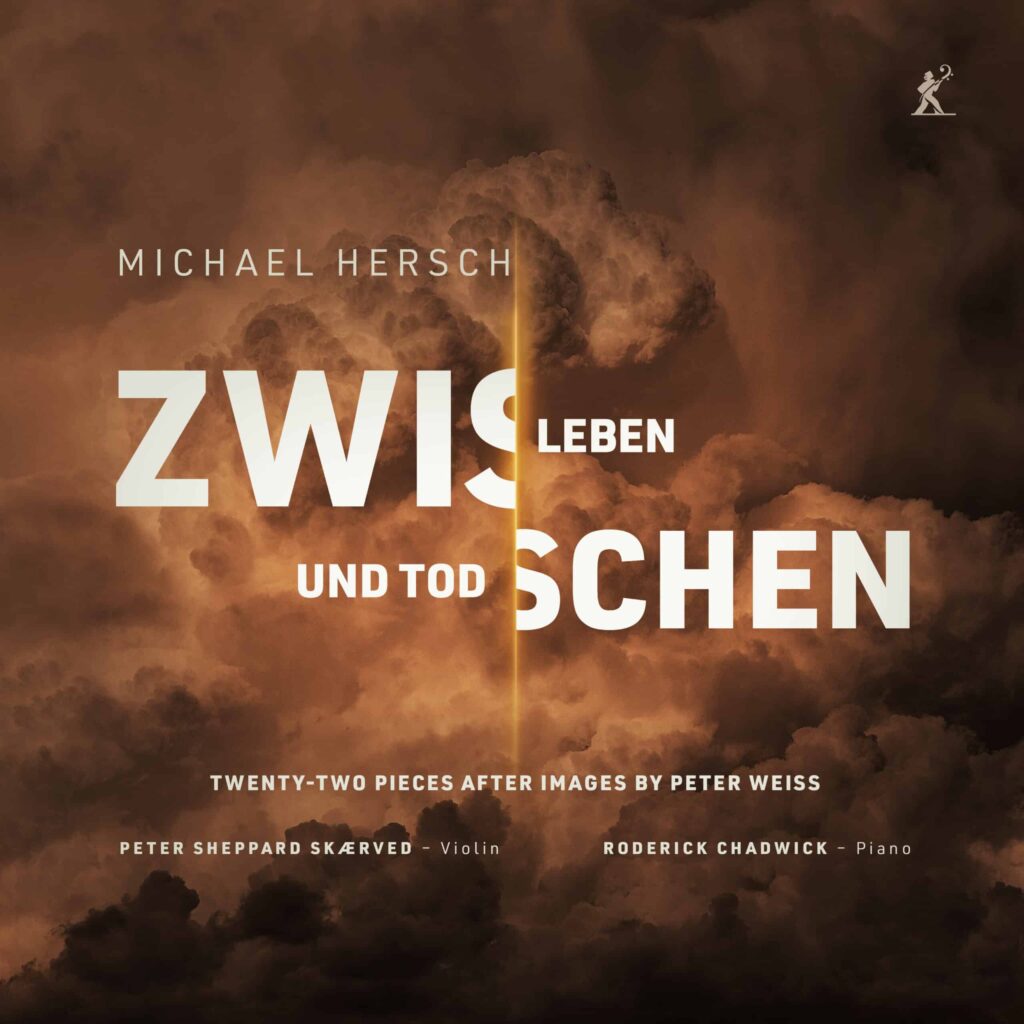
The subtitle of Michael Hersch’s Between Life and Death is “Twenty-two Pieces After Images by Peter Weiss.” You might remember Weiss (1916–1982) as the playwright of Marat/Sade, or perhaps for his massive novel The Aesthetics of Resistance. I was not aware that he also was a compelling visual artist (and a filmmaker too), creating intense works in a variety of styles. Some of his paintings resemble the work of Bosch and Breughel, some are influenced by surrealism, and some inhabit a similar world to that inhabited by Edvard Munch. Hersch, who has been inspired by visual art in earlier works, composed Zwischen Leben und Tod after he had become aware Weiss’s work while reading W. G. Sebald’s On the Natural History of Destruction.
In Zwischen Leben und Tod, which was premiered at Vanderbilt University in 2014, Hersch chose 22 of Weiss’s paintings or drawings and wrote music in response to each of them. (The 22 pieces probably should not be heard as illustrative or programmatic descriptions of the artworks.) Performances have been accompanied by projections of each artwork, although I am not sure if Hersch requires this. Unfortunately, Weiss’s works are not reproduced in Métier’s booklet—the small format would not do them justice anyway—although the booklet lists the titles of all 22 drawings or paintings. If you go to violinist Peter Sheppard Skærved’s website, you can find reproductions there, although you’ll probably want to look elsewhere for better-quality reproductions. You’ll gain an idea of what Weiss’s art looks like, and a hint about what Hersch’s music sounds like, from titles such as The Machines Attack Mankind, In the Courtyard of the Asylum, and The Cannibal Kitchen. The subject matter, when it isn’t terrifying, is at least melancholy or bleakly pessimistic. I was not surprised by this. The last work by Hersch that I reviewed in Fanfare was I hope we get a chance to visit soon, a work for voices and chamber ensemble in which the texts are by women who testify to their experiences with terminal cancer. No one gets out alive.
Hersch’s musical language is difficult on either side of the proscenium arch. One is immediately struck by the relentless double-stopping in the violin part and inside-the-instrument effects in the piano part. (In no way does the piano simply accompany the violin in this work. The two are equals.) There are sections in which the musical violence, and density, are almost overwhelming, and others (not so many, but enough) in which there is a torn and cracked beauty and nobility. (Mere prettiness, though? Not a chance.) Near the end of the work, No. 20 (inspired by Weiss’s Im Hinterhof, or “In the Backyard”), the music’s fragility is particularly memorable because of what has come before. But I don’t want to give the impression that Hersch’s music is gratuitously confrontational. It demands plenty from the listener, as well as from the performers, but his music consistently feels precise and sincere.
David Hackbridge Johnson, writing in PN Review, called this work “almost an opera without words.” Responding to the music’s emotional difficulty, he wrote that “a curiously cathartic sense is achieved; a sense of something endured yet survived, a procession of bleak images in sound that somehow resist despair.” I think that is an excellent description.
It’s not for me to criticize either Peter Sheppard Skærved or Roderick Chadwick who walk into the fire in this work, and come out on the other end still intact. It appears that this recording has the composer’s at least tacit approval, and that is good enough for me.
I know this release will not be for all of our readers. After my short acquaintance with it I don’t want to pretend that I have assimilated even most of it. I’m up for a challenge, though, when the stakes are high, and I don’t think anyone who makes it through the entirety of Zwischen Leben und Tod can do so without feeling that they were recalibrated in a perhaps small but nevertheless meaningful way.