







Purchase
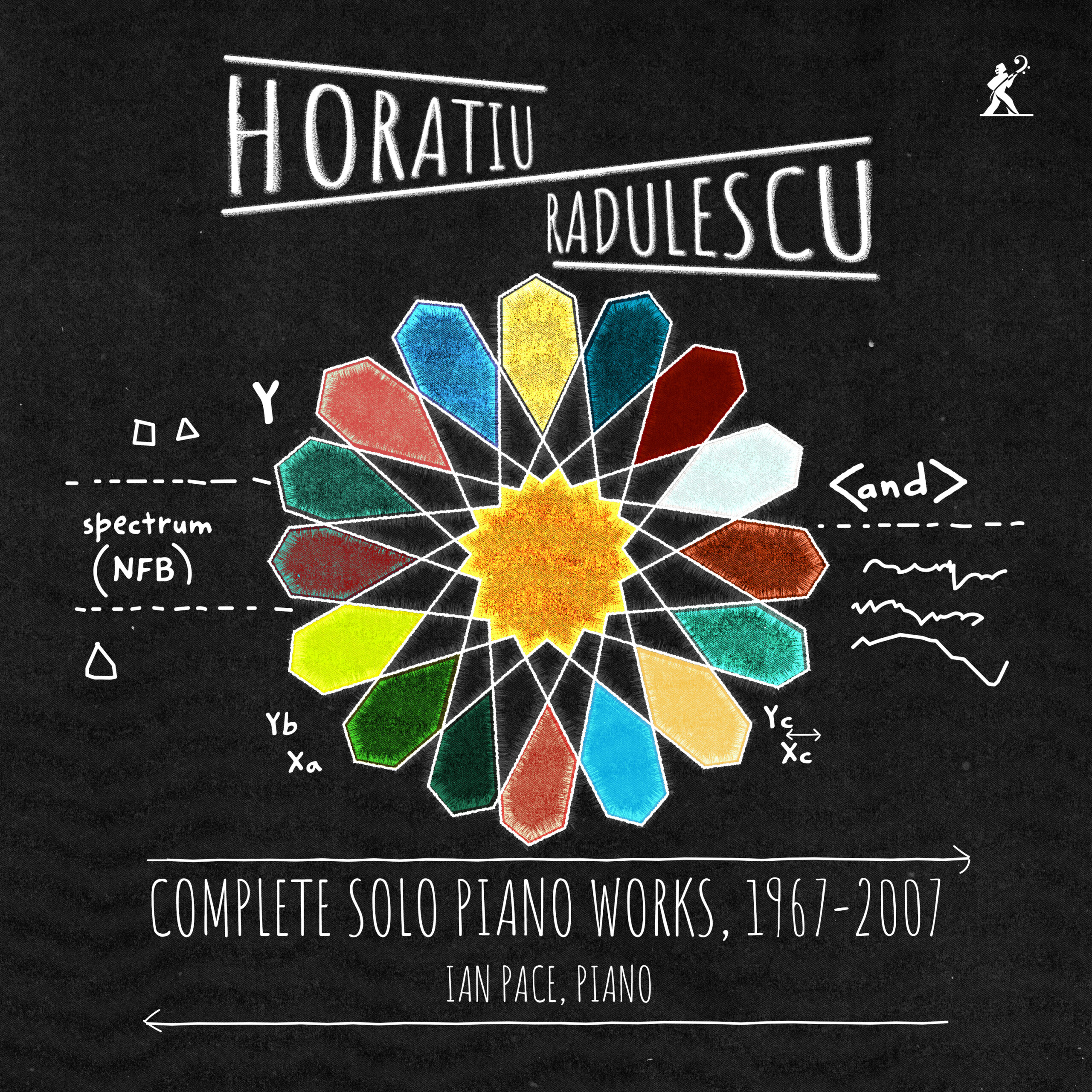
In September 2026, Métier Records presents an outstanding contemporary release – the complete acknowledged output for solo piano by Romanian composer Horaţiu Rădulescu, performed by premier Métier artist Ian Pace, a world-renowned interpreter of new music. Pace knew and worked closely with Rădulescu for many years and gave the world premiere of the Piano Sonata No. 6, specially written for him. The 2-CD set includes authoritative recordings of all six piano sonatas plus Omaggio a Domenico Scarlatti (1967), the first ever recording of The Origin π (1999), and an excellent, extensive article on these works by Ian Pace in the booklet notes.
Horaţiu Rădulescu was the leading figure in the field of Romanian spectral music, which derives massive, overwhelming sound masses from the very basics of harmonic spectra. In the second half of his career, he combined this with Romanian folk music and Byzantine chant, often in startling contrapuntal combinations employing techniques developed during the European Renaissance.
The first Piano Sonata “Wiege an den Abgründen/Cradle to Abysses” (1968) from his early student days in Bucharest alludes to Liszt’s final Symphonic Poem and features dramatic and austere music evoking a multitude of ‘Abysses’.
The remaining five are all closely linked and collectively known as the Lao Tzu Sonatas, inspired by the Taoist philosopher. Their chant-like or folk-derived materials are continually juxtaposed with more abstract spectral harmonies, derived in part from Rădulescu’s earlier idiom. They retain traces of song, ritual, and dance, but they are also transformed into something larger: continuous bodies of resonance, rhythm, and colour. The Second Sonata, “being and non-being create each other” (1991), composed 23 years after the first, is viewed as ushering in Rădulescu’s ‘second period’. The Third Sonata, “you will endure forever” (1992, rev. 1999), the largest of the six, is the first of Rădulescu’s piano works to draw explicitly upon pre-existing musical materials, specifically Byzantine chant. In the Fourth Sonata, “like a well … older than God” (1993), Rădulescu makes prominent use of three different Romanian Christmas carols, all originally collected and set by Bartók. The Fifth Sonata, “settle your dust, this is the primal identity” (2003) employs a wide range of Romanian folk melodies. The Sixth Sonata, “return to the source of light” (2007), was Rădulescu’s last completed work, and premiered by Ian Pace.
Omaggio a Domenico Scarlatti (1967) from the composer’s student days in Bucharest displays many aspects of post-war modernism and connects to the scale and performing features of Scarlatti’s keyboard music. The piano piece The Origin π(1999) is Rădulescu at his most uncompromising with what he calls ‘spectral resonance’ created by metal bars holding down all black notes and most white ones. The whole piece involves only two sounding pitches.
Rădulescu was born in Bucharest and studied violin with Enescu pupil Nina Alexandrescu at the Bucharest Academy. During this period, a shift came about from the dominant neo-classical style towards a greater engagement with European modernism. Rădulescu graduated in 1969 and went to Paris, taking French citizenship in 1974. Later in life he lived for periods in Germany and Switzerland, and like other émigré Romanian composers, his music was barely played at all during the remainder of the communist era.
Ian Pace has played in many countries and recorded over 40 CDs, including a series for Métier, including his latest recording of Michael Finnissy’s Piano Works, which was named a Best of 2025 by The New York Times, given well over 300 world premieres, and worked with many of the leading composers of today. He is also a scholar whose research and teaching exist at the intersections of musicology, cultural sociology, history, practice-research, critical theory, and the study of education. He is Professor of Music, Culture and Society at City St George’s, University of London, and writes regularly for a range of national publications.
Disc 1
Piano Sonata No. 6, Op. 110 “return to the source of light” (2007)
- I. use your own light (9:21)
- II. kalotrope of the Eternal (7:48)
- Omaggio a Domenico Scarlatti, Op. 2 (1967) (6:42)
Piano Sonata No. 1, Op. 5 Wiege an den Abgründen/Cradle to Abysses (1968)
- I. Giusto fluente – Meno mosso – Più mosso – Lento – Tempo primo (4:54)
- II. Allegro – Meno mosso – Tempo I – Poco meno mosso – Tempo I – Poco meno mosso – Tempo I
Piano Sonata No. 2, Op. 82 “being and non-being create each other” (1991)
- I. Immanence (9:12)
- II. Byzantine Bells (4:32)
- III. Joy (3:03)
Piano Sonata No. 4, Op. 92 “like a well … older than God” (1993)
- I. Trumpets of the Eternal (7:36)
- II. The Sacred Sound (4:15)
- III. Music…older than music (1:06)
- IV. Abyss (3:47)
Disc 2
Piano Sonta No. 5, Op. 106 “settle your dust, this is the primal identity” (2003)
- I. The Path Into the Light Seems Dark (10:46)
- II. Darkness within darkness, the gate of all understanding (3:27)
- III. Use your own light and return to the source of light. This is called ‘practicing eternity’ (4:15)
- The Origin π III, Op. 100 (6:21)
Piano Sonata No. 3, Op. 86 “you will endure forever” (1992, rev. 1999)
- I. If you stay in the center (6:56)
- II. and embrace death with your whole heart (6:47)
- III. Doina (1:51)
- IV. Dance of the Eternal (4:28)
- V. You will endure forever (7:05)
- 01 I. use your own light (9:21)
- 02 II. kalotrope of the Eternal (7:48)
- 03 Omaggio a Domenico Scarlatti, Op. 2 — (1967) (6:42)
- 04 I. Giusto fluente – Meno mosso – Più mosso – Lento – Tempo primo (4:54)
- 05 II. Allegro – Meno mosso – Tempo I – Poco meno mosso – Tempo I – Poco meno mosso – Tempo I
- 06 I. Immanence (9:12)
- 07 II. Byzantine Bells (4:32)
- 08 III. Joy (3:03)
- 09 I. Trumpets of the Eternal (7:36)
- 10 II. The Sacred Sound (4:15)
- 11 III. Music…older than music (1:06)
- 12 IV. Abyss (3:47)
- 13 I. The Path Into the Light Seems Dark (10:46)
- 14 II. Darkness within darkness, the gate of all understanding (3:27)
- 15 III. Use your own light and return to the source of light. This is called ‘practicing eternity’ (4:15)
- 16 The Origin π III, Op. 100 — (6:21)
- 17 I. If you stay in the center (6:56)
- 18 II. and embrace death with your whole heart (6:47)
- 19 III. Doina (1:51)
- 20 IV. Dance of the Eternal (4:28)
- 21 V. You will endure forever (7:05)