






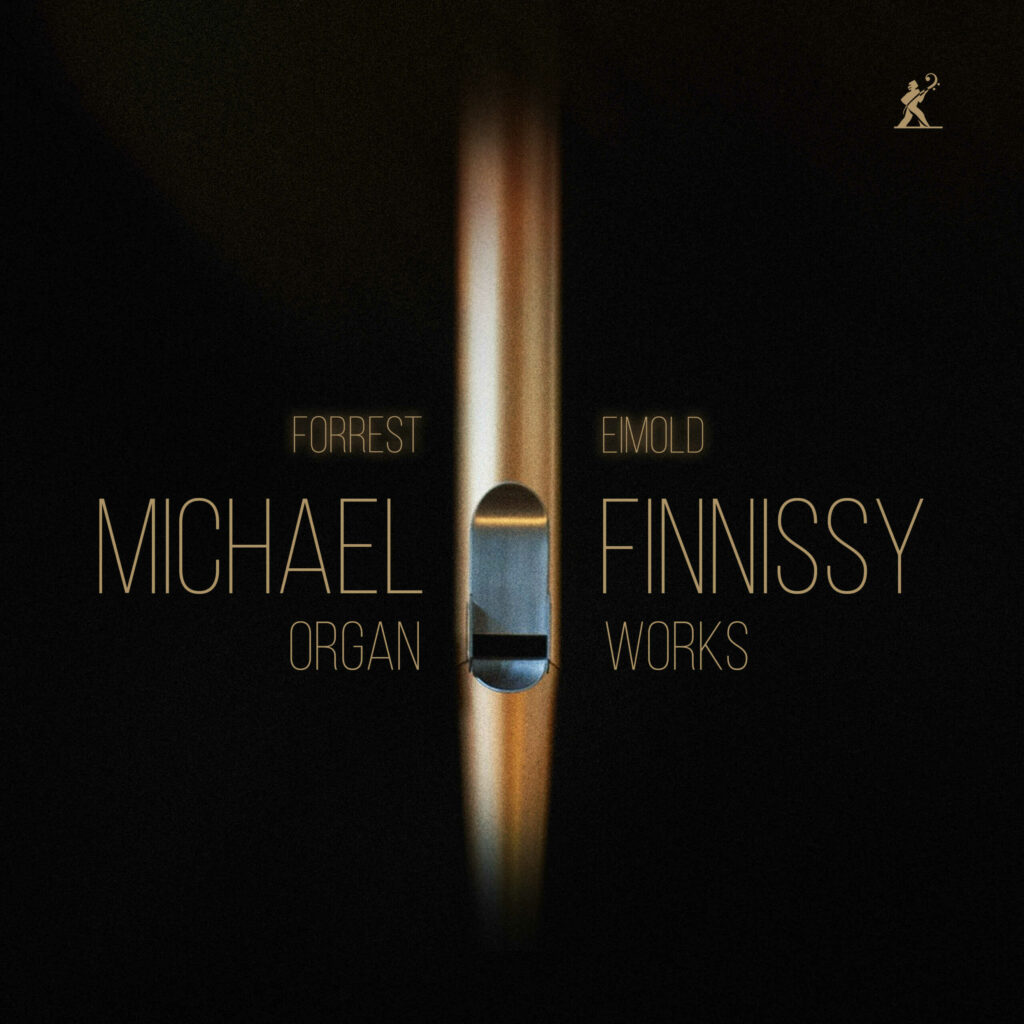
My first encounter with the music of British composer Michael Finnissy (b. 1946)—and, until I got this for review, my only one—came as a result of interviewing natural horn player Isaac Shieh for Fanfare 49:2. In connection with that I also reviewed Shieh’s release Caprice Reimagined, in which he took a set of 12 caprices for natural horn by French composer Jacques-François Gallay (1795–1864) and commissioned 12 living composers, including Finnissy, to write works inspired by or associated with Gallay’s pieces.
While the other composers Shieh commissioned just did one-off pieces, Finnissy responded with a set of six caprices of his own. Given the limits of what can be done with the natural horn, I was certainly curious about what Finnissy would do with the broader tonal and registral compass of the so-called “King of Instruments.” The answer surprised me because Finnissy actually did very little with it—and I mean that as a compliment.
In his works here—four so-called “Organ Symphonies” (like such 19th-century French composers as Charles-Marie Widor and Louis Vierne, he called his organ solo works “symphonies” instead of “sonatas”), a cycle of seven “hymn-tune preludes” inspired by but not evoking the sound world of Johann Sebastian Bach, and three one-offs—Finnissy seems to have been inspired by the technical challenge of how few of the organ’s resources he could use and how quietly he could make it play.
Occasionally these works contain sudden loud outbursts of sound, usually in tonal clusters like the ones at 10:25 and 12:28 of Symphony No. 1 or at the very beginning of Symphony No. 2. Mostly, however, these pieces are quiet and meditative. Some of them feature long stretches of silence that might make you think the piece is over—until it suddenly or slyly starts up again. Finnissy is also big on using drone effects, which he does quite powerfully through the entire last third of Symphony No. 4. These are the kinds of sounds an organ makes when some of its keys get stuck in the middle of a performance, but Finnissy is using them intentionally.
Finnissy started playing and composing music at age four, though he dates his first “proper compositions” from 1968. Liner-note writer Christopher Fox claims that the music on this two-CD set encompasses Finnissy’s whole career, which is true but only with modifications. The earliest piece on this release, … ere the set of sun … , was written in 1965 as introductory music for a student production of Shakespeare’s Macbeth at the Beckenham and Penge Grammar School. Xunthaeresis was composed in 1967 near the end of Finnissy’s term at the Royal College of Music, and Finnissy admits the title was a “silly” bit of pseudo-Greek intended to mean “synthesis,” which Fox says was a big concept in 1960s music.
The four organ symphonies were all composed within the first decade of the 21st century, though No. 3 is a transcription of a three-movement orchestral symphony Finnissy wrote in the early 1960s as part of his application for admission to the Royal College. The Seven Hymn-Tune Preludes, inspired by Bach but actually based either on Norwegian hymns (Nos. 2, 3, 5, and 6) or American “shape-note” songs (the rest), were composed between 2012 and 2022, while Blackburn, a tribute to the British city on whose cathedral organ much of this album was recorded, dates from 2022.
Finnissy is also an openly gay man, and he’s become more out front about it as his career has progressed. He’s written pieces that directly address queerness and homophobia, including English Country Tunes (1977), Shameful Vice (1994), Seventeen Immortal Homosexual Poets (1997), and Beat Generation Ballads (2016), the last an attack on former British Prime Minister Margaret Thatcher and the anti-gay legislation she pushed through Parliament. While Finnissy says he doesn’t want to be labeled as a “gay composer,” Fox’s liner notes acknowledge that the Organ Symphony No. 1 was inspired by a vacation Finnissy took in Norfolk with his partner, Philip Adams. Finnissy also serves as composer-in-residence for a lesbian/gay group at Harvard University and the Gay/Lesbian Mardi Gras in Sydney, Australia.
If Finnissy had sought to invent a performer perfectly suited to realize his organ music, he couldn’t have done a better job than Forrest Eimold. Born in Boston in 2000, Eimold identifies not only as “queer” but as transgender and what they call “agender,” usually referred to as “non-binary.” (As non-binary they use they/them pronouns even though they’re one person.) Eimold began playing keyboards at age four from a Casio toy sampler, graduating to a fully electronic instrument and then a century-old Baldwin upright a relative gave them. By age 10 they had enrolled in a Roman Catholic school to gain access to an organ. They came out as queer to one of their teachers, and as a result were enrolled in “conversion therapy.”
“I don’t mean conversion therapy in the sense of being taken to a licensed psychologist,” Eimold told Cy Gibson for a profile on The Blue-and-White website, “but it really was a sense of regularly meeting one-on-one with a person who was trying to get you to adjust your mindset and lifestyle.” Like Francis Poulenc, Eimold found themselves torn between the Catholic church and their true sexual and gender-identity nature. The would-be conversion therapists “helped me come to terms with myself and the world,” Eimold told Gibson. Now, Gibson explains, “Eimold rejects religious dogma through an overarching embrace of hybridity.”
Eimold went from strength to strength as a musician. At age 13 they had already learned Olivier Messiaen’s complete Livre du Saint-Sacrament, and in the next three years they added all of Messiaen’s post-WWII organ works to their repertoire. By 22 they were accompanying the Fauré Requiem not from Fauré’s organ reduction, but by sight reading the full orchestral score. They also earned their living by working as accompanist to singers and instrumentalists at the Juilliard School in New York, also playing directly from the orchestral score rather than a piano reduction. That, they explain, forces them to be composer and interpreter at the same time.
Eimold is also a composer themselves, and their most notable work to date is Full Fathom Two (2020), a work for two electric violinists in which the score specifies only a range of pitches, not actual notes. (Full Fathom Two, as performed by Olivia de Prato and Victor Lowrie Tafoya, violins, with Eimold on electronics, is available on YouTube in a post that displays Eimold’s original score: https://www.youtube.com/watch?v=sex6VOXtidU.)
Michael Finnissy’s organ music is a far cry from the loud, assertive, heaven-storming sound usually associated with the “King of Instruments.” Most of it is surprisingly quiet, meditative, and mellow. It is certainly worth listening to, especially in Forrest Eimold’s subtle and effective performances.