








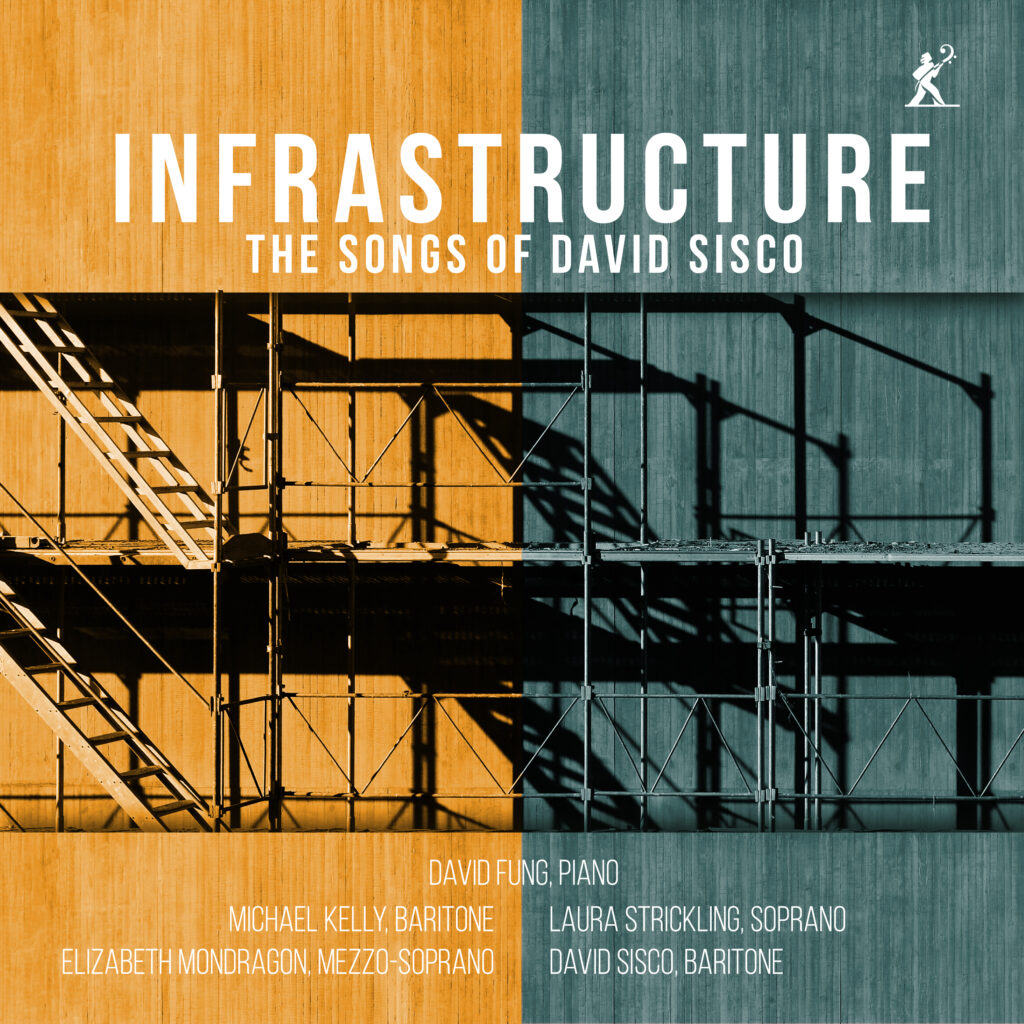
This disc presents an interesting confluence of performers, composer, and texts. The composer is David Sisco, and it’s instructive to see how his relationship with his texts has changed as his exploration of art song has developed over the years. That becomes striking if you look at it chronologically rather than in the order presented on the disc, which I’ll do here.
Patterns (2000) is a superb setting of an abridged version of the imagist poet Amy Lowell’s poem of the same name. It’s by far the most ambitious work on the disc. Sisco’s music has verve and searing clarity with a beautifully judged mystical opening, and it’s very intelligently sung by Elizabeth Mondragon, with heart-stopping emotion at times. Just riveting. Then there’s a lovely version of Francis Quarles’s 17th-century poem My Best Beloved (2003), which Michael Kelly invests with a sort of burnished lyricism and resonance, especially effective in the triumphant logic of Quarles’s final stanza. And Sisco’s music has a hint of an updated “Londonderry Air” to it, with all the warmth that implies, perfectly laid out.
What happens after that is interesting in terms of chosen texts. In 2004 Sisco was forwarded a chain email containing children’s prayers (in fact, they are taken from Stuart Hample and Eric Marshall’s collection Children’s Letters to God). He set some of them as Dear God, 12 songs that rush past with a lovely light touch, performed touchingly and wittily here by Laura Strickling.
Sisco set Barbara Worton’s poem Infrastructure in 2004, after meeting her. He says it “perfectly encapsulates a New Yorker’s scepticism—nay, neuroticism.” Well, it’s funny even if you’re not a New Yorker. Sisco’s music is even more inventive than Worton’s poem, and his own performance makes a strong case for it. Paul Sperry, the dedicatee of this album, also performed the song—which says a lot.
Where Memories Go to Die (2009) by Dennis Rhodes is a somewhat sentimental record of an encounter, a mistake, and an embarrassment, but it has real poignancy, especially as delivered here by the composer himself, whose music lends plausibility and a sense of evocation to the final image of a child’s sandcastle that could otherwise feel tacky.
What to say of Missed Connections? The vibe is music theater hits Craigslist: 11 short songs, settings of Craigslist posts. There’s real panache in Sisco’s writing and a delicious archness to Elizabeth Mondragon’s singing.
The poems in Italianate (2011) come from Up at the Villa: Travels with My Husband, a travelogue with poems and recipes by Linda Dini Jenkins, who is a friend of Sisco’s. The poems are light and frothy, and Sisco’s inventive settings capture that tone perfectly. Michael Kelly gives a committed performance, projecting an educated outsider in a Mediterranean world.
The Wrong Kind of Fountain Enthusiast is the most recent work here; the booklet gives no date, but Laura Strickling and Daniel Schlosberg premiered it in Chicago in May 2026, after the sessions for this album. Sisco explains that he had wanted to set Nicolas Slonimsky’s Lexicon of Musical Invective, was deterred by copyright, and turned instead to online reviews at Strickling’s suggestion, the two of them choosing the texts together. The substitution risks assuming that the two kinds of writing are interchangeable because both are savage. Slonimsky’s critics were professional writers, and their malice has cadence and timing; I was worried that would be lacking in the reviews. But they’ve been well chosen. The best of them is “Fresh & Tasty, But…”, twenty seconds long and genuinely funny. I also very much liked the pairing of the five-star and two-star reviews of Buckingham Fountain.
Time for some general observations. First, the composer and singers are lucky to have David Fung, a simply sensational pianist: virtuosic, imaginative, and exceptionally sensitive to every detail of these compositions. Second, I do absolutely agree with Sisco that art song will thrive through the setting of contemporary texts. There’s a clear movement in his work from established poetry toward an increasingly expansive idea of what an art song text can be, and he’s made the case persuasively that the choice of texts can be pretty catholic. Finally, I mentioned that Sisco dedicated the disc to Paul Sperry (1934–2024), who premiered works by some 40 composers, was part of the complete Ives songs recording project, and edited books of American song. The dedication is a lovely gesture, not least because Sisco’s own music has much to give to that genre.