








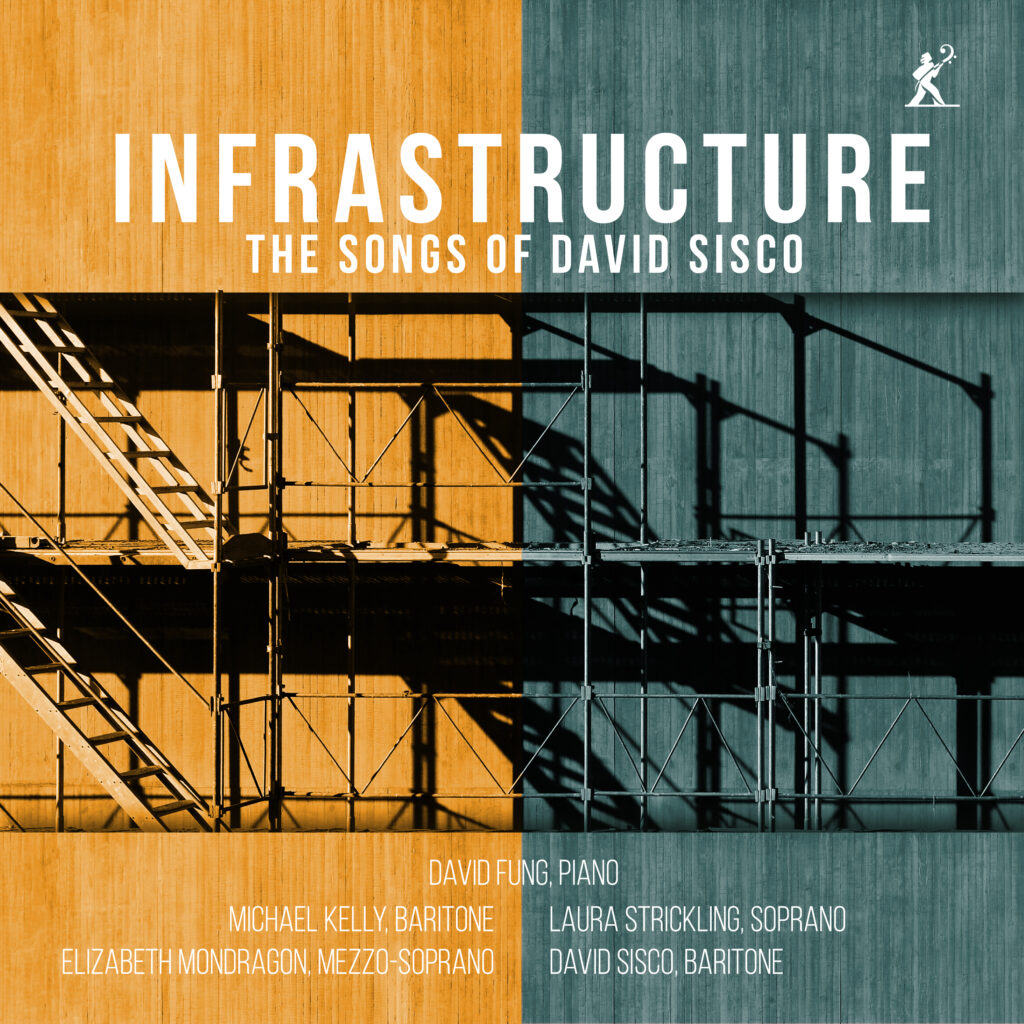
This release, called Infrastructure: The Songs of David Sisco, is a summing-up of Sisco’s work in the art song. “I began composing art songs during my undergraduate degree [studies] at Syracuse University,” he recalls in the program notes to this album. “I continued to hone my craft in the following years by collaborating with poets, singers, and pianists, each of whom illuminated the delicate alchemy of the art form. This recording represents over 25 years of my output as an art song composer.”
One of the most interesting aspects of this album is the wide variety of texts Sisco has set in his songs. Though two of the pieces, My Best Beloved and Patterns, are based on poems by acknowledged literary figures—Francis Quarles (c. 1592–1644) and Amy Lowell (1874–1925), respectively—the opening cycle, Italianate, is based on texts by modern writer Linda Dini Jenkins about her years in Italy with her husband. Another piece, Where Memories Go to Die, is a haunting song based on a poem by Dennis Rhodes.
Sisco recalled that he was browsing a bookstore in Provincetown, Massachusetts and looking at one of Rhodes’s books when the cashier asked Sisco if he’d like to meet the author. “He explained that Dennis lived in town, gave me his phone number, and suggested I reach out,” Sisco said. “We met for coffee, and Dennis was as delightful, vulnerable, and joy-filled as his poetry.” While When Memories Go to Die is only the last in a cycle of songs Sisco composed to texts by Rhodes (which whets my appetite for the chance to hear the rest of them!), it’s a quietly intense tale about the passing of generations reminiscent of the 1960s popular song “This Is All I Ask.”
In addition to the songs with texts by recognized poets, historical or modern, Sisco has used “found” texts for three of the cycles here, much in the way a collage artist uses pre-existing content to create new works of art. Missed Connections was drawn from the so-called “Missed Connections” page on the craigslist.com website, which was a considerably bigger deal in 2010 than it is now. The Wrong Kind of Fountain Enthusiast was originally inspired by a talk between Sisco and the soprano who sings it here, Laura Strickling, about doing a song cycle based on Nicholas Slonimsky’s The Lexicon of Musical Invective (1953). Concerned about running afoul of the book’s copyright, they shifted to gathering the texts from online reviews of restaurants, bars, high-end stores, and tourist attractions. The final cycle, Dear God, was taken from children’s prayers to the Deity.
Sisco has recruited a wide variety of singers to interpret his songs, including the woman he refers to as “my longtime muse,” mezzo-soprano Elizabeth Mondragon. Mondragon sings Missed Connections and also the Amy Lowell setting Patterns, which at 13:32 is by far the longest piece here, an intense, riveting psychodrama about a woman who loses her fiancé in World War I and decides she will never know a man or pursue love again. Mondragon expertly delineates the changes through which Lowell’s character goes, from innocence to exploring her own sexuality to grief and finally a determination to shut down her sexual and romantic sides forever.
Soprano Laura Strickling sings The Wrong Kind of Fountain Enthusiast and also Dear God. Baritone Michael Kelly performs Italianate and the one-off My Best Beloved, intriguing since both the singer and his beloved are described as male. (I suspect Francis Quarles didn’t originally intend that, especially since he lived in Elizabethan England, where homosexuality was a capital crime.) The other two songs, Infrastructure and Where Memories Go to Die, are sung by David Sisco himself. While his baritone voice doesn’t have the “ring” of Kelly’s, it’s a quite appealing instrument in its own right.
Sisco has said that, despite having earned both Bachelor’s and Master’s degrees in vocal performance, he developed a mental block against singing in public that he had to work to overcome. As he explained on his website, when he got to graduate school “I entered a very political, oppressive program that was more about tearing people down than helping them find their voice in the world. As a result, I spent many years battling severe anxiety around public performances, to the point of making myself sick. After doing my internal work, I have finally reclaimed this part of my life and have rekindled the joy I feel for sharing the gifts I was given with others.”
Mention should also be made of the remarkable pianist, David Fung, who plays throughout the album even though the singers change. Sisco has written a series of piano parts that change radically between songs in a cycle and even within the same song. He also requires his pianist to shade over from strict classical to ragtime, jazz, and boogie. Fung eats up all the challenges of Sisco’s piano writing and provides superlative accompaniments throughout.
When I first heard David Sisco’s Infrastructure (the title is a reference to the physical aspects of New York City) I chuckled at the banality of some of the texts and wondered if the classics of German Lieder and French chansons sound as silly to native speakers of those languages, and not to us, only because we don’t understand them. Sisco is a great songwriter who shows a superb command of a wide range of musical styles to communicate his texts, and the various singers and Fung do expert jobs of interpreting the songs. Definitely recommended.