








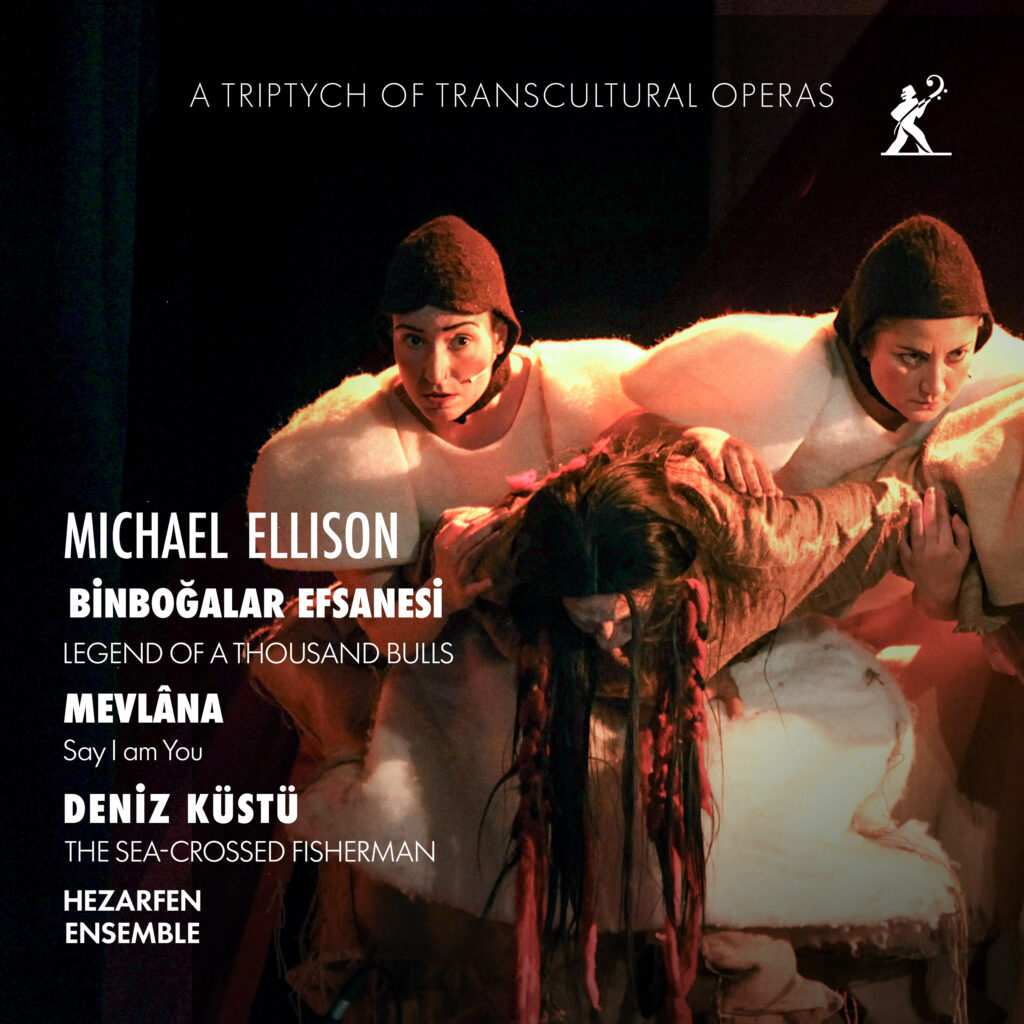
A “triptych of transcultural operas” by Michael Ellison, this expands Fanfare’s coverage of this composer exponentially: there have only been two short pieces reviewed before, Henry V (Fanfare 17:2) and Before All Beginning (Fanfare 22:3), both on the MMR label, and both reviewed in 1999.
The first opera is Legend of a Thousand Bulls (Binbğalar Efsanesi) to a libretto based on Yaşar Kamali’s novel of the same name, set as a sequence of eight “episodes.” A number of what Ellison calls “Captions” move the story on, but instrumentally. Unseen (for us listeners) dancers wander in a circular fashion. The story concerns the disappearance of nomads in Turkey. The chief protagonist is “bozlak voice” (Turkish folk singer) Ceren, in love with a tribal leader who has been forced into mountain exile: the theme of displacement links viscerally to events of today. Sung in Turkish (the libretto is available via QR code in the booklet, or typing out a printed URL in a browser), the scene is set evocatively. The instrumental Prelude (1947, the night of May 5) is modernistic, but with perhaps a near-Orientalist accent. The music is evocative of night, the performance exceptional in both technique and understanding. Haydar (Erdem Şimşek) opens, infinitely melismatic, a meditation on good and evil, and a reflection on how close they are as two stars meet. Anyone who sees those stars will have their wish granted; his voice is full, expressive, and there is infinite space in his solo; two narrators (Canan Özgür, Feride Büyükdenktas) provide commentary, their voices falling over one another. The performance is stunning: the ensemble (a mix of Occidental and Turkish instruments) is exceptional: listen for when players and singers are in rhythmic unison.
Ellison’s use of dance is noteworthy: a song to Allah, marked as “instrumental,” has a pronounced male chorus element, and is absolutely infectious. The composer shifts from twilight to night effectively, too, as Karem wishes for a falcon (heard via the narrator sung by Canan Özgür), initiating a sequence of prayers and wishes. Ellison sets these with a sense of mystery, even foreboding (wishes might not end well, remember). But it is Ceren’s hymn to a star and plea for his beloved, that is so unforgettable. Fatma Aydoğan is extraordinary not only in vocal flexibility but also in her portrayal of internal pain. This is impassioned, but a quiet sort of passion.
There is an internal fire that runs through this opera, nowhere more apparent than in the third Episode, “In Search of Wintering Gardens,” initiated by a dance (“Davil-Sipsi”) and those extraordinary Narrators, as the poet explores ideas of wandering and of misuses of power, particularly as regards the fate of the world itself. Dialogues are sometimes related via the pair of Narrators; sections are clearly delineated. A case in point is the arrival of Haydar, close to the third Episode, “From Khorasan we come,” a moment of remarkable musical relation, but also of powerful words: “Like packs of wolves, we enthralled a whole age … But never did we humble their pride.” It is less than three minutes, but music of such exceptional power, its emotive force the natural outgrowth of the music preceding. Complementing that is Ceren’s gentle “I hear them all, The cries of lambs and kids, sound across the plain,” where the music caresses like the sweetest of breezes (that’s not fanciful, it really does have that effect). Aydoğan really is a singer to remember, and Ellison scores with minimal means, throwing her voice into the spotlight while supporting it, softly. Her pain at “Let’s die then, but die true to ourselves” (Episode Four) is a proper cri de coeur. Ellison has the ability to convey every emotion: Ceren’s description of Halil’s blood “collecting in a pool on the ground” against slowly grinding instruments is unforgettable, the composer somehow conveying the juxtapositions of beauty and horror of the text through a slowly dripping, almost rotating repeated gesture. Later, Ceren’s hallucination (Episode Six) is a masterstroke of less-is-more from Ellison, as it should be: this is a real dramatic turning point. She changes her mind, and agrees to marry Oktay Bey (the seventh Episode depicts the celebratory energy at this decision).
Erdem Şimşek is superb throughout; although he does not round off the opera, he rounds off the first disc, offering a prayer of hope and a reminder of his peoples’ strength, and opens the second, acting as a sort of bridge. Ellison’s juxtaposition of Haydar with the Narrators offers a moment of such remarkable beauty, while Haydar’s assertion that underneath all the corruption, “somewhere, unbowed, goodness and generosity remain.” All this against images of a mother who has to carry her dead baby on her back for days. The use of Anatolian instruments gives huge local flavor, obviously; but what emerges more is the sheer variety of color and expression they can achieve via expert playing (including swarms of insects in the fifth Episode). This is all about place and displacement, after all: the demise of an ancient pastoral way of life crippled then destroyed in the name of modernization. The sound world might be region specific, but the message is global. When Ceren sings, “We’ve been dragged to police stations, beaten, spat on. There was nothing we could do about it,” that cry could come from any number of nations currently. The opera closes with a return to the opening scene, but now reframed, with no happy ending.
At just shy of 111 minutes, Legend of a Thousand Bulls is the longest of the three operas: the other two come in at 80 and 69 minutes respectively. The cast is exceptional, and Istanbul-born conductor Can Okan ensures a carefully aligned infinite palette from his singers and players.
The second opera, Say I Am You (Mevlȃna, heard on the third disc), is cast in two acts subdivided into eight tableaux (four + four) and was recorded in 2012 at MIAM Studios, Istanbul. The singers are all from VOCALLAB Nederland, an integrative collective that develops new vocal music in collaboration with film, art, theater, and dance. On this release, we miss out on Tessa Joosse’s video scenography, but we can experience the story of the transformation of Jelaluddin Rumi (Mevlȃna) from scholar to mystic via a “wandering dervish” (Shams-i Tabriz). As in Legend of a Thousand Bulls, the opera ends where it began.
Although the opera is in English, it includes some Arabic. Melike, the mezzo Ekaterina Levental, sings in English, though, “I dreamed of a time …” (the libretto is by the composer, and based on Rumi). The instrumental ensemble is mainly Occidental (violin, viola, cello, double bass, piccolo/flute/alto flute and clarinet/bass clarinet) supplemented by ney (reed flute) and kanun (a type of zither) and backed by percussion. Ellison’s use of (unseen) chorus to interact with and react to Melike’s words is wonderfully assured. Melike is undergoing something of an existential crisis: “Listen to the reeds!” is the whispering chorus’s reply. The scene shifts to the city gates of the Turkish city of Konya in 1244 and we are introduced to the magnificent vocal presence of baritone Arnaut Lems as Mevlȃna.
The plangent tenor of Gunnar Brandt-Sigurdsson enlivens the part of Shams (who vows to destroy the lies that hold Rumi back); both he and Levental (whom he enters into dialogue with) ensure there is no need to follow the libretto: their diction is phenomenal. Much of Shams’s delivery is intense, and so loud; Brandt-Sigurdsson seems pretty tireless. The tinta of this opera is definably different from the first, and, now with different singers and players under Lucas Vis, the music appears just as colorfully and with its own identity. There are parallels, though, with the chorus carrying a similar function to the two Narrators of A Thousand Bulls. Its tale of enlightenment and of entwined souls (the tale of the Mouse and the Frog told by Melike and Veled in the fifth tableau at the beginning of the second act) is profound, but the delivery often quite light, reminding us of the deep truths of fairy tale as well as legend. There is no weak link in the cast. As a piece, it packs a little less of a punch than the first opera of the set, which of course befits its subject matter.
The performance is, to my ears, faultless. Care seems to have been taken at the most minute, micro-level. Singers phrase with great accuracy, not only at pitch level, but with careful slurs. Ellison’s transparent scoring (as at Melike’s “My dear father,” Tableau VI) faultlessly balanced.
The 2016 opera The Sea-Crossed Fisherman (Deniz Küstü) is based on the “proto-environmentalist novel” by Yaşar Kamal, adapted by Simon Jones. The setting is Istanbul, and again the ensemble includes Turkish instruments. Two murders and environmental repercussions are depicted via video in live performance, with the dolphin gaining paramount importance (interestingly, the libretto refers to Jonah and the dolphin, not Jonah and the whale: there is even a “Dolphin Dance”).
Described as “Total music Theatre in Four Scenes,” that’s where the Wagner parallels stop, on an immediate level at least. Set in a coffee house outside Istanbul, with villagers returning from the funeral of a gangster, seen by the street-child Zeynel. There is a distinct feel of this as ensemble opera, both in terms of vocal tuttis and smaller groupings (there are moments of real beauty in the second scene). There is also a surreal feel to the action (“a Police Officer enters the coffee house and breaks the reverie, passing the MERMAID as she exits quickly …”).
Gwion Thomas is a strong Selim (Zeynel), gaining in strength toward his long scene 2 monologue while fishing, “It’s a month no I’ve been after him”; Robyn Allegra Parton narrates well, but I do wonder if she wasn’t just a touch too far from the microphones in stage placement at the end of the first scene? It is live, after all; and that is a tiny point given the clout this music holds.
Out of the silence of the end of the first scene (the opera is in one act, four scenes) comes the “Sea Music” that launches scene 2, about as far from Britten or Debussy as one can get and yet still mobile, still evocative.
We obviously miss out on the dance element again (“The DANCER playing the Swordfish movies upstage with the line …”; “A DANCER who has been sitting drinking tea, stands up to perform the DOLPHIN”); but it is absolutely right to release this music, a statement that subsists for all three operas.
The third scene concerns Selim’s flight; villagers read out newspaper headlines about sightings (while the headline, “Zeynel disappears near Old Seraglio” offers an irresistible Mozart reference, surely). Ellison depicts a series of chases, and mixes realities easily on one stage. But it would all make more sense viewed, of course. Ellison’s music can appear almost cartoonish (a Turkish cartoon, for sure), which seems to add to this Theater of the Absurd. A bit of detective work is required to work out who sings the Fortune Teller heard in scene 3 (Parton).
At last, “Selim Builds a House” (scene 4), a scene which ends in positivity but in which Selim’s moods swoop up and down like a swallow in full flight. But overall I found The Sea-Crossed Fisherman the last satisfying of the three operas: the score is a little too busy, a little too unrelenting. But there are touching and tender moments, for sure, and this music very much deserves hearing—and, ideally, experiencing in the opera house. Again, the opera has its own distinct “feel.”
A very recommendable release that surely puts Michael Ellison on the musical map.