






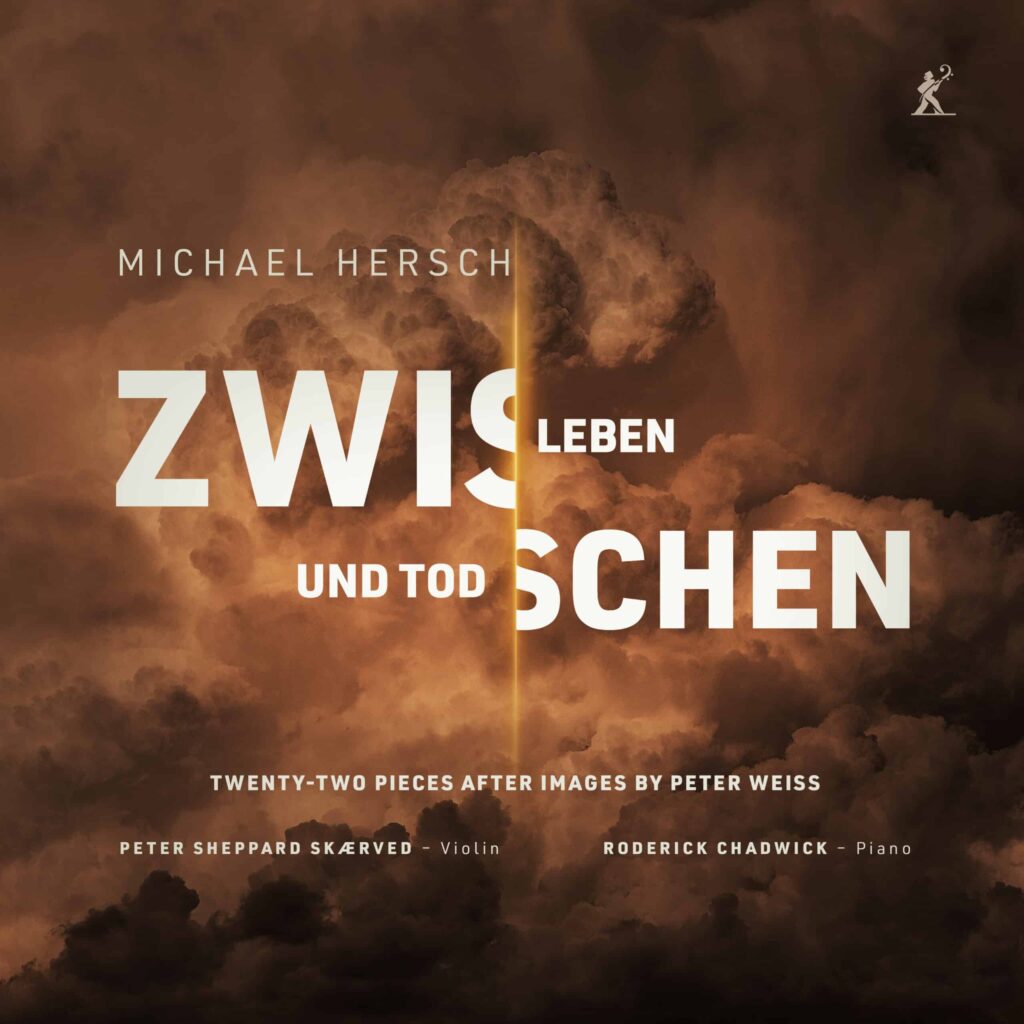
Billed by Métier as one of the longest works ever written for violin and piano, this initially rebarbative, ultimately compelling sequence is given a committed premiere recording here by regular duo partners Peter Sheppard Skærved and Roderick Chadwick. Subtitled ‘twenty-two pieces after images by Peter Weiss’ (better known as the playwright of Marat/Sade fame), it seeks to respond to the images’ atmosphere of, as the composer describes it, ‘pronounced disquiet, looming threat, longing violence or grief, or both of these states simultaneously’, but also to their formal qualities: colour and motion, proportion and spacing. Hersch seems to have envisaged, and initially insisted on, performances in which the paintings were projected in the performance space, Sheppard Skærved has commented in a recent interview on the fact that ‘over the years, as [Chadwick and I] got closer to the music, the importance of the paintings lessened; and indeed, the extensive and handsomely presented (if rather carelessly edited) booklet accompanying the release includes a list of titles, but no reproductions. It is, I think, the right decision. The work feels less like a series of programmatic commentaries than a sustained journey of contemplation – a musicalisation not so much of the images themselves as of the composer’s mind contemplating them. Furthermore, the drawings and paintings do not form a designated group or sequence, and are, despite commonalities of mood and subject matter, quite disparate in manner. The music, by contrast, is cumulative in force and in some ways remarkably singleminded. That’s not to say there isn’t a great variety of expression – slow and fast, sparse and full, dissonant and consonant – but one soon comes to realise that it’s all made out of a relatively small collection of recurring ideas, just as the two instruments, which operate so often in tandem in this work, are clearly aspects of a single consciousness. Sheppard Skærved and Chadwick are scrupulously attentive both to each other and to the detail of the score, never prettifying or normalising, faithful to all the multifarious ways in which Hersch keeps his music fragile: its often slow (sometimes extremely so) tempos and occasional fast eruptions, the violin’s near-constant double-stops and frequent movement between sul tasto and sul ponticello, the notes produced inside the body of the piano and the registral and dynamic extremes for both instruments. There’s no obvious single moment at which the prevailing sombreness lifts, but after nearly an hour and three-quarters of such remarkable commitment from both composer and performers one reaches the end with the sense of, as David Hackbridge Johnson suggests in a perceptive essay, ‘something endured yet survived, a procession of bleak images in sound that somehow resists despair’.
—John Fallas