








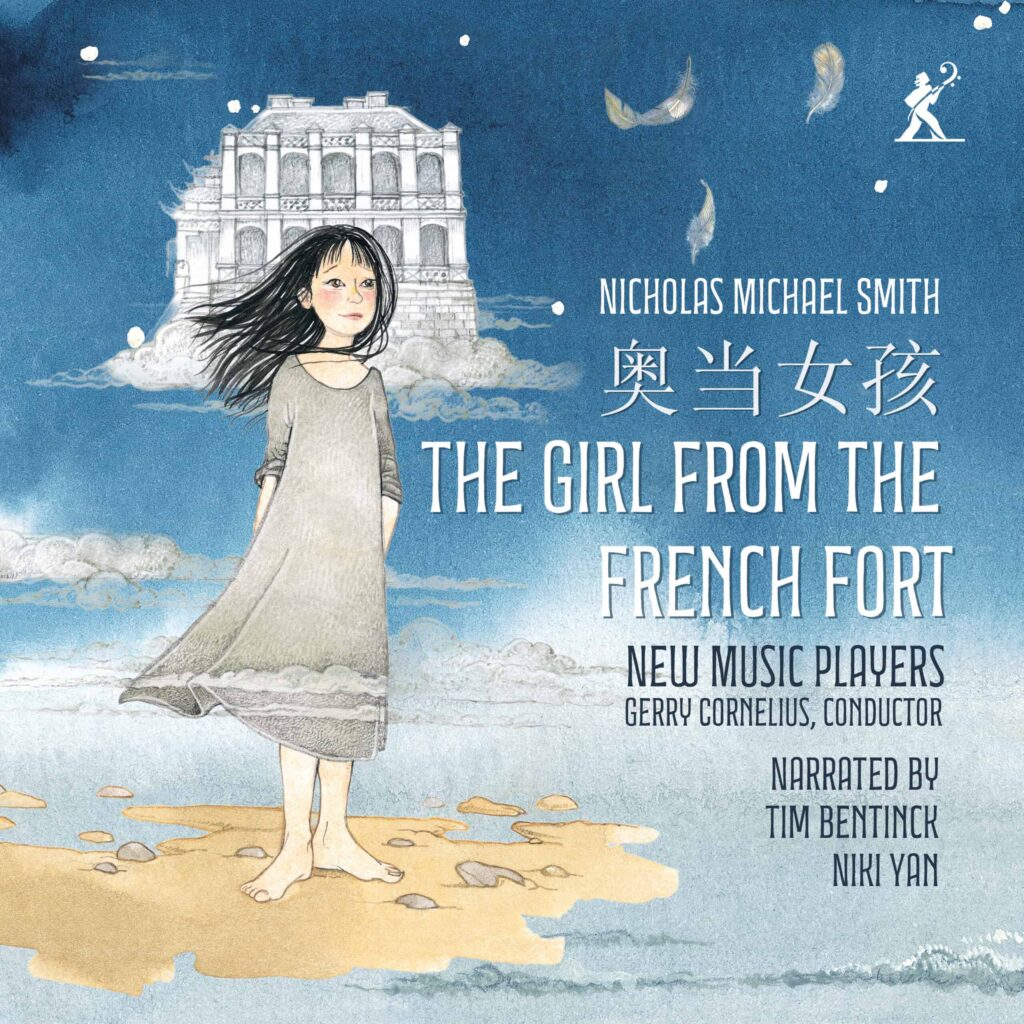
The Girl from the French Fort is a magical realism story set in 1970s Chongqing, China, featuring a young boy named Sangsang who is befriended by a mysterious girl in an old riverside fort. It is a time-travel fantasy about childhood, love, and loss.
The story follows Sangsang, a boy from a poor family who finds a dreamlike, ‘heaven-like’ world inside an old military camp, sometimes referred to as the French Fort, along the Yangtze River. He encounters foreign sailors and a mysterious girl, with the narrative exploring themes of love, loss, and the resilience of childhood.
This is a collaboration between the composer, Nicholas Michael Smith, who has lived in China for many years and who freely acknowledges the influence of the country’s culture in his music and the Chinese author Hong Ying, who is ‘best known in the English-speaking world for her literature, her photography and her gourmet cooking.’
In his introductory note, Paul R. Flynn explains that the work is following in the tradition of Prokofiev’s Peter and the Wolf, a work, the notes inform us, with which it is often programmed. As in Prokofiev’s work, the piece blends narration with orchestral colour which not only depicts the incidents in the plot, but also tracks the fluid emotional landscape. It is often said that comparisons are both invidious and unhelpful.
Smith’s musical language is complex and an intriguing combination of elements of the Western classical music tradition with its ‘harmonic tensions and chromatic development’, but at other times, ‘his melodic lines float freely around a tonal centre, moving in the circularity of the pentatonic scale’ which is central to much traditional Chinese music. The mix is extraordinarily effective because the various elements are completely and successfully integrated.
The main difference between this work and Prokofiev’s is that, while the narrative deals most effectively with the themes of childhood, loss, love and the perception of time, unlike Peter and the Wolf, at no timeisthere a genuine sense of peril. This should not be accounted as a fault, but merely a difference. It is presented in two versions, one in English and the other in Chinese. The notes in the insert are similarly bilingual.
I found this to be a most effective work, but I think that it must be accepted on its own terms; even the comparison with Peter and the Wolf is of limited value, although both works should appeal to children of all ages.