








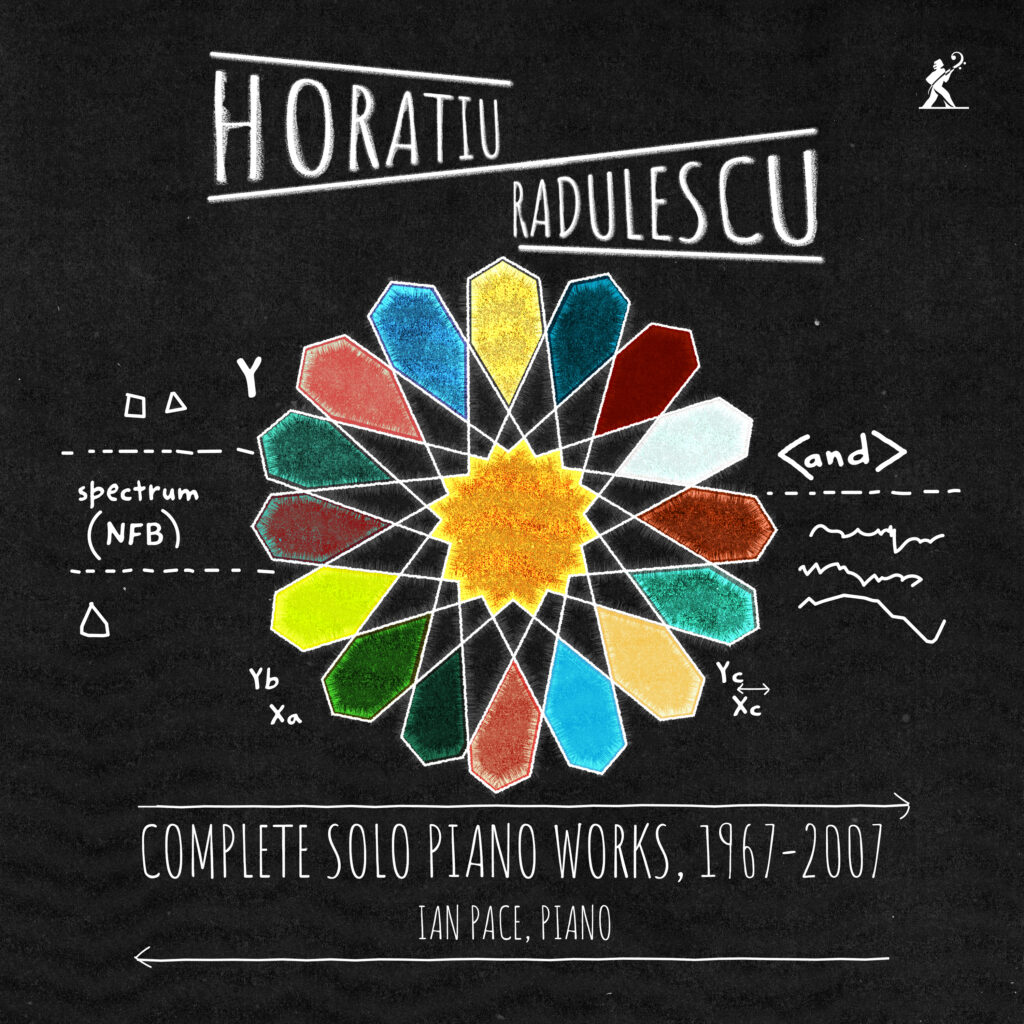
Following his Michael Finnissy odyssey Complete Solo Piano Works, 1967-2007 (A/25), Ian Pace turns to Horațiu Rădulescu (1942-2008) who, while he may also never have made the transition from cult artist to mainstream composer, is himself widely considered to be a seminal figure in post-war European music.
Anyone who possesses the set of piano music from Ortwin Stürmer will find Pace assuredly his own man, and not least as regards programming. Starting at the end with the Sixth Sonata (2007) is a boldly provocative choice, its visceral content bringing together Rădulescu’s philosophical and musical concerns in an eloquent summation. ‘In my end is my beginning’ – witness those sudden upsurges and outbursts that disrupt the methodical serialism of Omaggio a Domenico Scarlatti(1967) or the fervent imagery of the First Sonata (1968), tangibly inspired by Scriabin.
Rădulescu belatedly returned to the piano – rendered a ‘sound icon’ – when amalgamating his harmonic innovations with the possibilities of the tempered scale; his next three sonatas being inspired by the Taoist philosopher Lao Zhu. Pace has the measure of the Second (1991) with its scintillating figuration or Messiaenic resoundings into silence, and the Fourth (1993) with its aural imagery at once ecstatic and apocalyptic. Its idiom duly enriched by elements of the Romanian folk music this composer drew on increasingly, the Fifth Sonata (2003) also has a modal subtlety making it the most approachable of this cycle, while the Third (1992), with its avowedly personal take on the textural finesse of Ligeti and rhythmic intricacy of Nancarrow, is the most inclusive in content and hence the obvious work with which to conclude this traversal.
Stürmer was crucial in encouraging Rădulescu’s return to the piano, his precision and panache conveyed with impressive clarity, but Pace’s combative and inquiring spirit is no less apposite for this music. He also includes The Origin ∞ III(1999), which encapsulates the composer’s late aesthetic in miniature, whereas Stürmer features the Piano Concerto, placing his thinking in a more panoramic context. With sound of unremitting impact and booklet notes taking longer to read than listening to the set, Pace provides unstinting advocacy for this singular composer.