








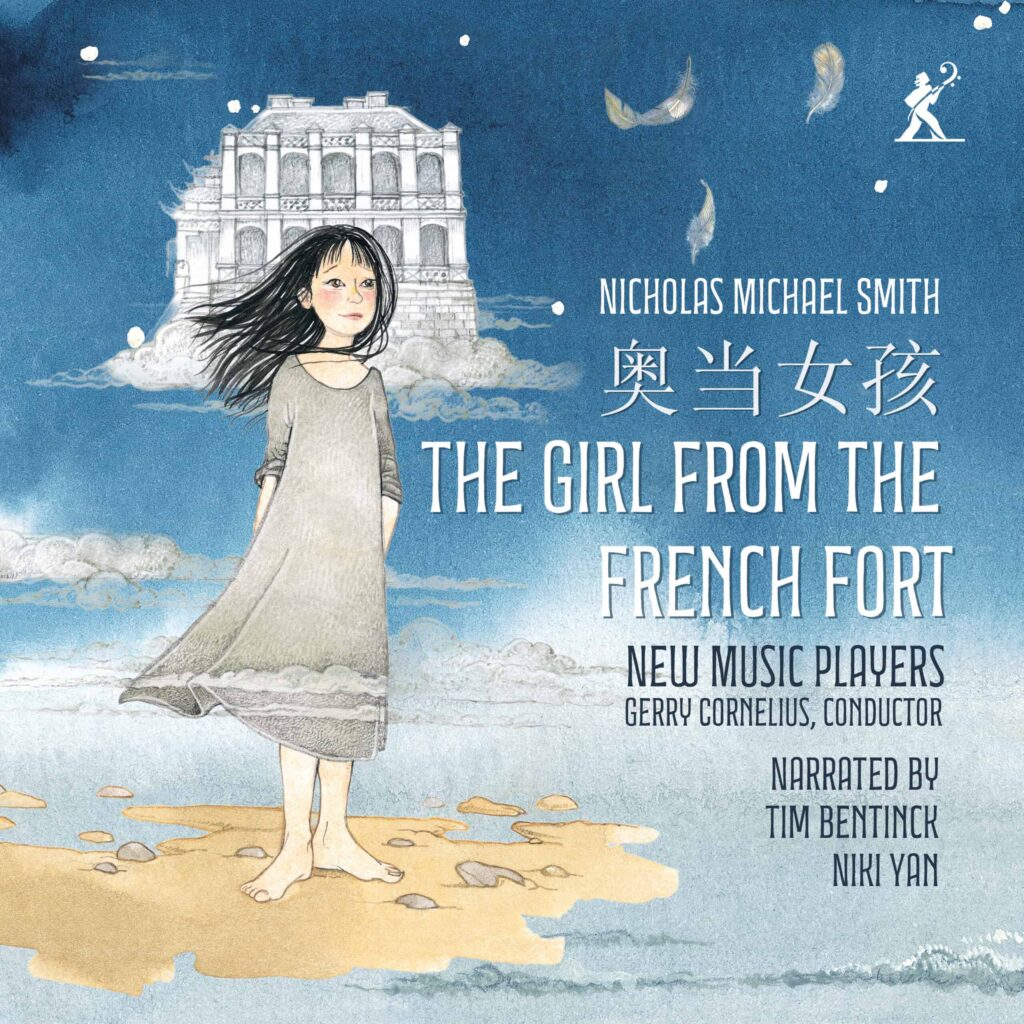
Composer Nick Smith made his home in China over thirty years ago. He has been involved in countless musical groups and ensembles in that time, both amateur and professional; performing, teaching and composing. His own music is infused with all that is good about China. It is refreshing, tuneful, dreamy. It feels pure and true, orchestrated in the western classical fashion but breathing the air of ancient Cathay. He uses the idiom of Chinese folk themes, but the tunes and melodies are of his own making. There are now well over twenty full time symphony orchestras in China, and many millions of young people play string, wind and brass instruments to a very high standard.
This new recording features Smith’s narrated piece The Girl from the French Fort. I think the work dates from around 2015. It is given here in two versions, one in English and the other in Mandarin. It is scored for strings (5/5/3/3/2), single woodwinds, three horns, trumpet, trombone and percussion. This is very similar to the orchestration of Prokofiev’s Peter and the Wolf with which it shares many obvious similarities. The story is absolutely enchanting. As a teacher of thirty years’ experience, I guarantee anyone under fourteen will be spellbound by it. The author Hong Ying has written a series of stories featuring the main character Sangsang; Smith has collaborated with her on more than one occasion.
The recording was made in November 2024 at the time the work was performed in London coupled with a more recent Smith-Ying project, the one-act opera The Stone God. Like the work under review, the opera is set in Chongqing, a major river port on the Yangtze. Now a major hub with over 20 million inhabitants, Hong Ying’s books look back to a more peaceful, quieter era. The booklet included has some charming illustrations and a useful essay by M.A. Aldrich in which he charts the history of children’s fiction in China from its root teaching of the Confucian values of truth, piety, loyalty and goodness through the influences of western Christian missionaries and the Maoist era, all the way to today’s modern Chinese writers.
A boy of around ten years of age called Sangsang lives with his mum and grandparents close to the river in an area of town called Turtle Rock. He is brave, kind and true. His theme is first heard lightly orchestrated on woodwind, taken up gently by the strings thereafter. Smith lets us feel the river and paints colourfully as Sangsang rescues a pigeon from a cat (flute, clarinet, trumpet and trombone vividly characterising). He skims flat pebbles across the river and meets a little girl. She catches on quickly and the innocence of their music takes wing and sparkles brightly as her own pebbles seem to twinkle and fly with a magic Sangsang can’t fail to notice.
The old French fort comes into view with a stately theme and references to the Marseillaise. As soon as the happy pair enter inside, the dilapidated fortress is transformed into an elegant hub of refined chivalry. There is life, colour and flowers. The place buzzes with activity as a French frigate is sighted about to dock. Smith writes a charming waltz theme to illustrate the lush banquet that Sangsang and his new friend attend as honoured guests. The little girl’s sister, Meiniang is excited to welcome back her sweetheart who is an officer on board the ship. He has terrible news, though. He is called back to France to marry another. It is sunrise now and Sangang leaves. It has been the most wonderful night of his life but the unexpected twist at the end and Meiniang’s sadness casts a shadow on him as he plods home with heavy steps.
Smith’s music is very descriptive, tuneful and listenable. He is clearly as adept a storyteller as Hong Ying herself. The dreamworld inside the fortress is brought to life with gentleness and careful skill. When Sangang finally arrives home, the scene he surveys is not what he expected. He has been away six months or more. In the long days of waiting and searching for him, his beloved mother has died from grief. The villagers return to the fort with Sangsang but it is the same overgrown deserted ruin it always was. Sangsang has really done it this time: his lies, his neglect, his selfishness have brought tragedy to the family. Smith writes a sombre funeral march-like dirge with tolling timpani. Left alone we hear his theme, forlorn now on woodwind.
Back on the shores of the great Yangtze, he meets the little girl once more. He is led there by the feather she gave him. She performs an “anticlockwise dance” that will wind back the time for Sangsang. Clicking, tapping and Brittenesque chords are very effective. How can Sangsang repay the girl? Did I mention that the fantasy dream night in the castle is repeating like a closed loop “Groundhog Day”? The little girl, Meiniang and all the characters have been trapped there for centuries. Once again, Sangsang and his magic friend go inside. This time Sangsang does everything differently. He will break the cycle and prevent the sad meeting between Meiniang and her beloved. Do I hear a reference to Der Rosenkavalier this time in those three horns? There is some gorgeous blossoming music as we reach the climax. Sangsang has done it. He parts from his new friends and is reunited with his mother. They embrace and walk along the riverside. The tale is over.
I really enjoyed this little creation, sculpted with such care and love by Nick Smith and Hong Ying. The story is adorable and narrated very nicely by Timothy Bentinck. The Chinese version is read by Niki Yan. Gerry Cornelius conducts the New Music Players. The whole piece lasts just under 33 minutes in duration. If you are looking for a nice piece of that length to sit and enjoy with a treasured little one, perhaps as a one-off bedtime story on a special occasion, this would fit the bill admirably.